
PHP2Shell: When a Vulnerability Becomes a Business Risk
Two critical PHP vulnerabilities can allow unauthenticated remote code execution on affected web systems. Exploitation attempts have already been observed. For organizations, the challenge is not only patching quickly, it is knowing where they are exposed and whether that exposure has already become an incident.
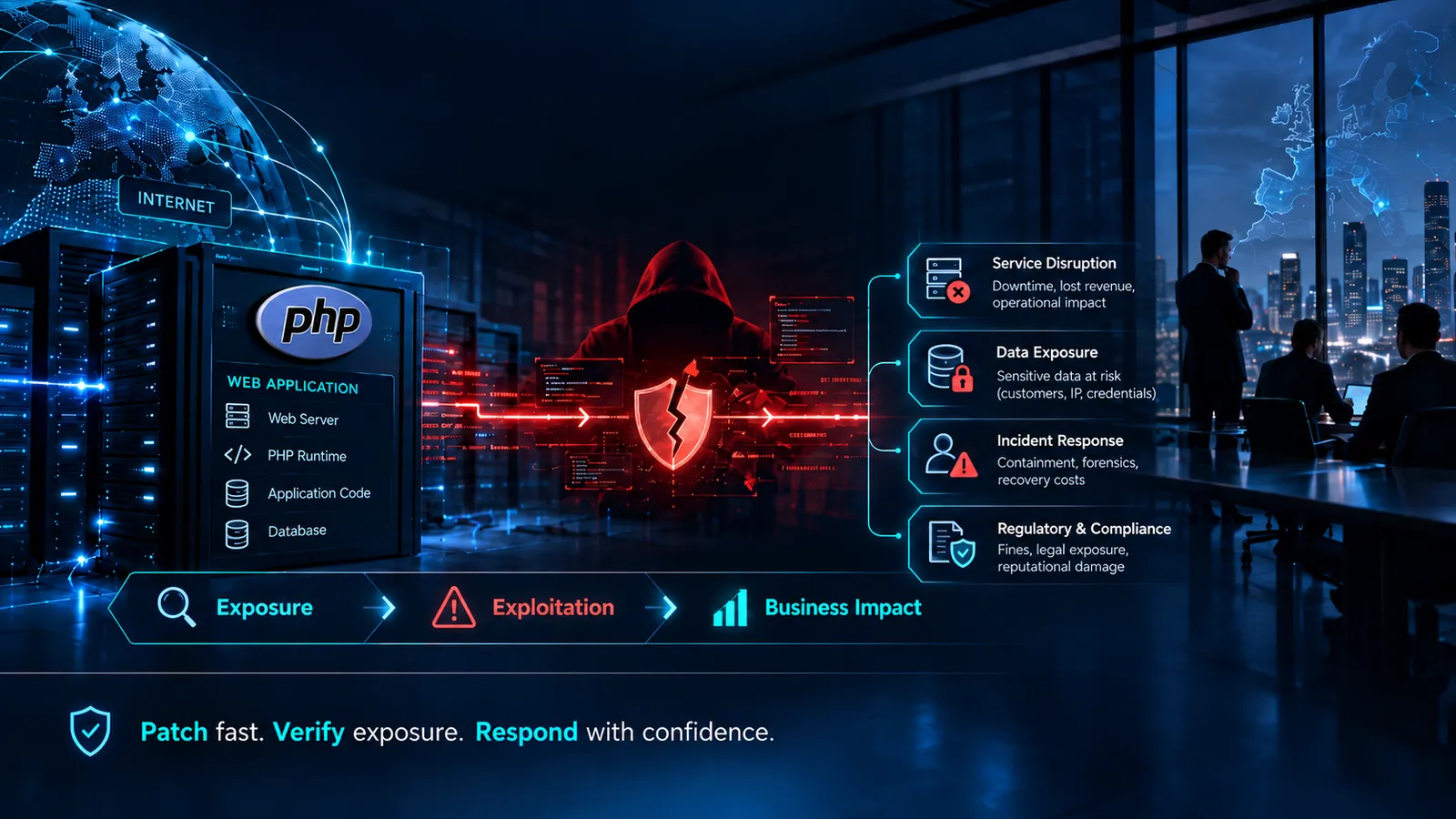
PHP2Shell: The Patch Is Only Half the Answer
On 21 October 2026, the PHP project released emergency security updates addressing two critical vulnerabilities now widely referred to as PHP2Shell.
CVE-2026-109618 and CVE-2026-109619 are both rated Critical, with a CVSS score of 9.2, and can allow unauthenticated remote code execution on affected PHP web environments.
The risk is no longer theoretical.
Amazon Threat Intelligence identified an exploitation attempt dating back to 17 October — four days before public disclosure. Public proof-of-concept exploits appeared around the disclosure window, and subsequent exploitation attempts have been observed in the wild.
For organisations running PHP, this changes the conversation.
The question is no longer simply:
“Do we need to patch?”
The answer to that is yes.
The more important question is:
“Were we exposed before we patched — and would we know if that exposure had already become an incident?”
Why PHP2Shell matters to businesses
PHP remains deeply embedded across web infrastructure.
It may power:
- public websites;
- customer portals;
- e-commerce platforms;
- APIs;
- administrative interfaces;
- internal applications;
- third-party products and appliances.
This creates an important visibility problem.
An organisation may not think of itself as a “PHP environment” while still having PHP running somewhere inside a customer-facing application, legacy system or third-party product.
That is why PHP2Shell is not simply a developer problem.
It is an asset visibility, vulnerability management and incident readiness problem.
A critical vulnerability becomes a business risk when three things meet:
An exposed system. A viable exploit. And an organisation that does not know quickly enough whether the two have met.
The CVE is technical. The consequence is business.
What is the actual risk?
Successful exploitation can allow an unauthenticated attacker to execute code with the privileges of the affected web server process.
From a business perspective, that may create a path toward:
- server compromise;
- access to application or process-accessible data;
- credential exposure;
- further access to connected systems;
- service disruption;
- incident response costs;
- regulatory or contractual consequences.
This does not mean every vulnerable PHP server will automatically lead to a major compromise.
Exploitability can depend on the PHP version, architecture and configuration.
But when a critical remote code execution vulnerability affects an internet-facing system, the potential impact is significant enough that organisations should not treat remediation as a routine monthly patching task.
The first problem: do you know where PHP is running?
Before an organisation can remediate PHP2Shell, it needs to identify its exposure.
And that may be harder than it sounds.
PHP can exist in systems that are not immediately obvious from the asset inventory, including third-party applications and bundled software.
Leadership should therefore be able to get clear answers to five questions:
| Question | Why it matters |
|---|---|
| Are we affected? | You cannot remediate an asset you do not know exists. |
| Which affected systems are internet-facing? | Public exposure changes the urgency and likelihood of attack. |
| Have those systems been patched? | Updating is the only complete remediation for the two vulnerabilities. |
| Were they exposed before the fix? | Exploitation attempts were observed before public disclosure. |
| Would we know if exploitation occurred? | Closing the vulnerability does not establish what happened before it was closed. |
This is where mature vulnerability management differs from simply maintaining a patch list.
The priority is not just severity.
It is severity + exploitability + exposure + business impact.
The second problem: the exploitation window has already opened
The PHP project released patched versions on 21 October:
- PHP 8.2.35
- PHP 8.3.36
- PHP 8.4.27
- PHP 8.5.12
The PHP project is explicit that there is no complete configuration-only mitigation for the two vulnerabilities.
Updating is the reliable fix.
But the timeline matters.
Amazon Threat Intelligence observed an exploitation attempt on 17 October, before coordinated disclosure.
By 21 October, proof-of-concept exploit code was already appearing publicly.
Sophos subsequently reported multiple exploitation attempts and at least one successful exploitation consistent with PHP2Shell activity.
For defenders, that illustrates a broader reality:
The time between vulnerability disclosure and real-world exploitation is increasingly measured in hours, not weeks.
A vulnerability management process designed around a fixed monthly cadence may therefore be too slow for high-impact, internet-facing vulnerabilities.
Patching answers one question, not all of them
Applying the security update removes the known vulnerable condition.
That is essential.
But patching does not tell the organisation what happened while the system was exposed.
If an affected internet-facing server was reachable before remediation, management should still be able to answer:
Was there suspicious activity?
Did the system behave unexpectedly?
Was anything else affected?
Do we have enough evidence to confidently close the issue?
This is why vulnerability management, threat intelligence, monitoring and incident response increasingly need to work together.
The objective is not merely:
Patch faster.
It is:
Know what matters, reduce the exposure, and recognise when a vulnerability becomes an incident.
What leadership should take from PHP2Shell
PHP2Shell is a useful test of an organisation’s operational security capability.
Not because every organisation should understand PHP memory management.
Leadership does not need to.
It should instead be able to ask:
- Are we affected?
- Are exposed systems patched?
- Were we exposed before the fix?
- Would we know if exploitation occurred?
- Can we contain it quickly if it did?
If those questions are difficult to answer, the problem is bigger than PHP2Shell.
It points to gaps in asset visibility, vulnerability prioritisation, monitoring or incident readiness.
And the next critical vulnerability will create the same challenge.
How Avencyx can help you
PHP2Shell is exactly the kind of threat where several parts of the security programme need to work together.
Avencyx helps organisations move from a public security advisory to an evidence-based understanding of their actual risk.
Risk-based vulnerability management
Avencyx MDR prioritises vulnerabilities according to exploitability and business impact, rather than treating every CVE as equally urgent.
For a vulnerability such as PHP2Shell, that means identifying affected assets, understanding which systems are exposed and prioritising remediation where the real risk is highest.
Threat intelligence translated into action
Avencyx integrates cyber threat intelligence into detection, prioritisation and exposure decisions.
The objective is not simply to tell clients that a new vulnerability exists.
It is to answer:
Does it affect us?
How exposed are we?
How quickly do we need to act?
24/7 monitoring and threat detection
Once remediation is underway, another question remains:
Was the vulnerability already exploited?
Avencyx MDR combines continuous monitoring, detection engineering and threat hunting to identify meaningful activity and reduce the time between suspicious behaviour and action.
This turns vulnerability management from a purely preventive activity into part of a wider detection and response capability.
Incident response when exposure becomes compromise
If evidence suggests that exploitation may have occurred, Avencyx can escalate from MDR into its Digital Forensics and Incident Response capability.
Avencyx DFIR focuses on containment first, structured investigation, evidence preservation and prioritised recovery.
The distinction matters:
Patching fixes the vulnerability. Incident response establishes whether the vulnerability became an incident.
Validate rather than assume
Through Avencyx Advisory & Offensive Security, organisations can also validate whether remediation and security controls work as expected.
Testing is prioritised by real-world exploitability and business impact, helping leadership move from:
“We believe we are protected.”
to:
“We have evidence that the risk has been reduced.”
The takeaway
PHP2Shell deserves immediate attention because it combines three characteristics organisations should take seriously:
critical impact, internet exposure and demonstrated exploitation activity.
But the larger lesson extends beyond PHP.
The next critical vulnerability will arrive.
The organisations best prepared for it will not simply be those that patch quickly.
They will be the organisations that know what they own, understand what is exposed, prioritise according to real risk, detect suspicious activity early and can respond quickly when prevention is no longer enough.
Patch the vulnerability. Prove it never became an incident.
Further Reading
Frequently asked questions
What is PHP2Shell?
PHP2Shell is the name commonly used for two critical vulnerabilities in PHP: CVE-2026-109618 and CVE-2026-109619. Both can allow unauthenticated remote code execution under affected conditions, meaning an attacker may be able to execute code on a vulnerable server without first authenticating.
Which PHP versions are affected by PHP2Shell?
Versions prior to the security releases published on 21 October 2026 are affected. The fixed versions for currently supported branches are PHP 8.2.35, 8.3.36, 8.4.27 and 8.5.12. Organizations running older end-of-life PHP branches should plan migration to a supported version rather than relying on legacy deployments.
Is PHP2Shell being exploited?
Yes, exploitation activity has been observed. Amazon Threat Intelligence identified an exploitation attempt dating to 17 October 2026, before public disclosure. Public proof-of-concept code subsequently became available, and Sophos reported multiple exploitation attempts and at least one successful exploitation. Updating to a fixed PHP version is the only complete remediation for the vulnerabilities themselves. However, if an affected system was internet-facing before it was patched, organisations should also consider whether there is evidence that exploitation occurred during the exposure window. Patching removes the vulnerability. It does not establish the historical state of the system.
How can an organisation know whether PHP2Shell affects it?
The organisation first needs visibility into where PHP is actually running. That should include public-facing infrastructure, internal applications and PHP embedded in third-party products or appliances. Once affected assets are identified, they can be prioritised according to version, internet exposure and business criticality.